Why this page?
In this section you will find the accessibility measures that will be implemented, as well as those that will not be implemented during this first edition of BAF Camp. By explaining which measures will be in place during the festival, we hope to allow everyone to make an informed decision about attending and/or bringing the equipment they need with full knowledge of the accessibility of our space.
We are drawing on the work of Les Dévalideuses to build this approach.
Source:lesdevalideuses.org
An accessible space is a space that works to avoid reproducing systemic violence and normalized oppression in our society.
We have chosen to implement only certain measures for practical reasons (lack of time, funding, concrete obstacles encountered on the ground and not anticipated in advance). These shortcomings are not the result of a hierarchy of discriminations nor a political choice. If a future edition of BAF Camp takes place, we will work further on implementing the missing measures while also taking into account the feedback we receive.
We are aware that these measures will not be sufficient for some people to attend, and that this lack constitutes an additional form of exclusionary violence. We are sorry for that.
In addition, the festival programme and organization were mainly built by able-bodied, white, francophone people, which concentrates power among them and means the event will not be fully mixed but will only tend toward inclusivity, which may itself represent another form of "violence".
These measures were notably developed using the Les Dévalideuses accessibility guide.
🤲 Care team
- Non-mixed spaces on the festival site (camping, chill space, some workshops).
- A violence barometer has been established with a qualified person, so the care team can follow a clear protocol in case of violence.
- A care cell will welcome people who want to rest in a calm and safe space and offer active listening. Active listening can help participants process incidents of violence that may have occurred at the festival and enable the care team to respond according to the wishes of the person who experienced or witnessed the violence.
- A trained street medics team will be present for medical help.
- A surveillance system will run 24/7 on the camp (with staff at night) for everyone's physical and emotional safety and comfort.
- There is no phone line for the care cell during the festival.
- We cannot guarantee the presence of a trained person for every potential discrimination (queerphobia, ableism, etc.), but we will do everything possible to find suitable solutions.
🎪 Festival-goers' commitment
- A charter reflecting the values of BAF Camp has been written and read by all staff, who commit to following it.
- A briefing at reception will raise awareness among festival-goers about possible discrimination and violence, and the measures planned in response.
- A ticketing charter, summarizing the overall charter, will be signed by festival-goers when buying a ticket. In case of non-compliance, measures will be taken by the care team.
🛠️ Staff training
- The staff have received training on violence in festival settings.
- The care team will brief as many people as possible during setup on issues of classism, LGBTQIA+ violence, dis/ability and VSS.
- A professional from ASBL Tilt will train staff and volunteers twice on racism in festivals.
- No training is given by professionals on classism, LGBTQIA+ violence, dis/ability or VSS.
🌸 General measures
- Spaces for disabled people will be marked with flowers to avoid stigmatizing signage.
- The fridge will be accessible to store food for specific diets and medication.
- Flower-shaped pins will indicate a visible or invisible disability for those who want to use them (their meaning will be explained to everyone).
- A customizable badge will be available (name/blaze, pronouns, social battery, language, etc.).
- An SNJ-style tent with around ten camp beds, more comfortable than regular camping, will be accessible on request — limited places, to be booked by email: activismcampbelgium@proton.me.
- There is no dedicated contact person for the punctual reception of disabled visitors, but a reference person will be available for questions about the measures.
🧒 Children's accessibility
- A space for and by children, with materials to build games and activities, supported by experienced volunteers for two hours in the morning and two in the afternoon. The space will remain accessible outside these periods without supervision.
- Activities accessible to children throughout the festival (improvisation, gardening workshops, and more).
- Changing tables available in or near the washing spaces.
- The fridge will be accessible for food for babies.
👁️ Visual accessibility
- Large orientation panels will indicate the different spaces of the festival.
- Paths and spaces will be sufficiently lit to move around easily.
- Facilitators will be invited to describe the visual parts of their workshops.
- There is no dedicated person to greet and orient blind or partially sighted people.
- No braille materials.
- Guide dogs are not welcome, following the request of the property owner.
👂 Auditory accessibility
- More than 60% of workshops will be given in French. Activities in the two large chapiteaux (150p) will be translated into English, Dutch and French. English or Dutch workshops will happen throughout the day.
- No sign language translation.
- No closed captioning or magnetic loop system.
- No specific provision for deaf-blind people (tactile sign language, haptic communication).
- No sign language classes during the camp.
📍 Spatial accessibility
There will probably be no access matting on the festival site. The ground is grassy and partly sloped: access to our festival will already be extremely limited for many people with reduced mobility. We are sincerely sorry for this. Accessible areas without slopes are mainly those located along the river (marked in blue on the map). Some workshop areas and the chill zone are located on sloped ground.
🚆 Path from the station
The train journey to Grupont requires at least one change at Rochefort-Jemelle. Since Rochefort-Jemelle station is not independently accessible, assistance for boarding and disembarking must be booked with SNCB at least 24 hours in advance. The route indicated for festival-goers is a forest path. However, we will also provide an alternative access route for people requiring a more accessible surface. Via this route, Grupont station is located approximately 400 meters from the festival grounds. The station does not have an accessibility ramp, and a 3-step staircase must be used when leaving the platform. The road between the station and the festival is paved but lacks sidewalks in certain sections. The first 200 meters are very steep, and the final 100 meters consist of asphalt mixed with gravel.
⛺ Ground layout
The festival takes place on grassy terrain. The campsite is reached from the festival by a steep dirt path of 200 meters. The site includes several elevated spaces (slopes ranging from 1 to 3 meters) and areas located on either side of a wooden footbridge. Most other spaces (canteen, bar, main marquees) are on the flat part of the site. The terrain is bordered by a river, which can make the atmosphere very humid and cold at night.
- PMR parking spaces will be provided near the entrance. However, we cannot guarantee they will remain permanently available: it may be necessary to drop the person as close as possible to the site, then park the car in the village to keep emergency access clear.
View the plan
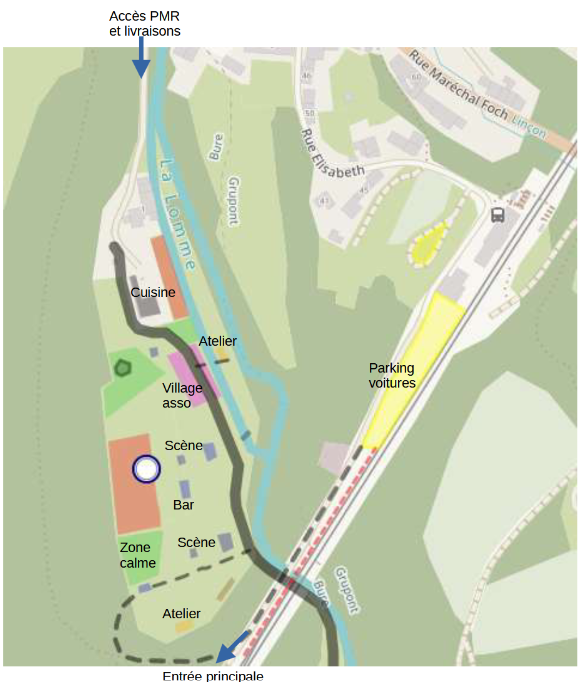
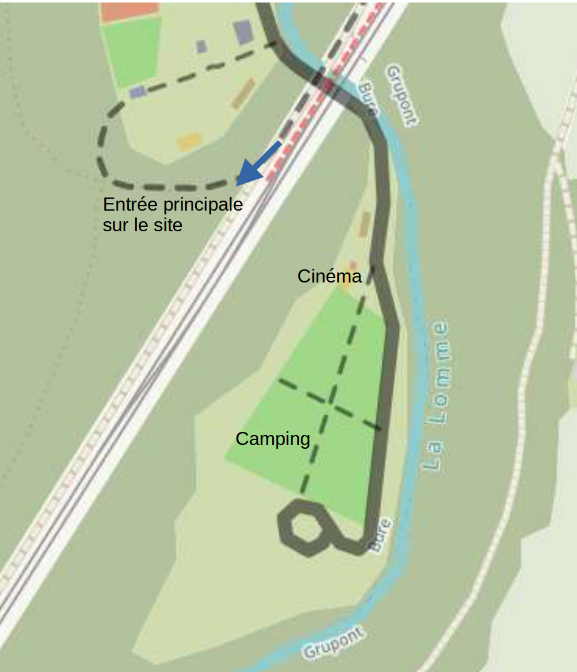
- Risky areas (holes, river) will be marked with tape or signs.
- PMR needs have been taken into account in the emergency evacuation plans.
- No guarantee that there will be accessible toilets and washing facilities for PMR users (enough space, handrails, wide door).
- No dedicated PMR spaces in the different locations. However, on request, we will ensure people can be placed near the stage and we will reserve seats for this purpose.
- We cannot guarantee a variety of seating everywhere, but we are working on it.
- No IMO vehicle available from the festival to collect people from the station.
🏞️ Sensory accessibility
- An info space will provide a map and programme, and allow questions about organization (time or place changes).
- Facilitators will be invited to indicate the expected stimulation level (TW, visual effects, violence, shouting), and this information will be available in the programme or at the info point. There will be no strobe lights on festival stages.
- A chill area without sound and a quiet space in the care zone (as much as possible given the size of the festival). However, due to the festival's relatively small size, noise from stages may still reach the care zone.
- Noise-reducing headphones will be available in the care area.
- No accessible sound meter for the different stages.
- Information will not be made visually or audibly accessible (pictograms, images).
- Schedule changes will be displayed at the info space, but we cannot guarantee that everyone will be informed via, for example, a festival-wide sound system.
🧠 Cognitive accessibility
- Clear signage will indicate the location of different spaces, with maps available at reception.
- Self-managed tents for activities of your choice, as well as chill and quiet spaces to write or read without interacting.
- In the large chapiteaux, it will be possible to ask questions in writing or express opinions, transmitted to facilitators, so people can participate without speaking publicly.
- No writing in FALC (Easy to Read and Understand) for this edition, which makes our communication less accessible. We hope to implement it in a future edition.
🧼 Sanitary accessibility
- Masks and gel available in the care space.
- Hand sanitizer distributed before entering the canteen.
- The capacity of each space is limited and will be specified on the programme.
- Wearing a mask will not be mandatory.
- No requirement to present a negative PCR test to enter the festival.
🎒 What to bring
- Food / water: your plate or bowl + spoon + cup, and something to eat or snack on if you want (food will be available on site on a pay-what-you-can basis).
- Sun: cap or hat, sunglasses, sunscreen.
- Hygiene: toiletry bag, towel, mosquito repellent.
- Money: bring cash.
- Clothes: enough for the whole stay, including warm clothes for the night: the meadow can be damp and nights can be cold.
- Your bottle: to stay hydrated throughout the festival.
- Your tent: if you sleep on site.
- Sleeping bag: a warm sleeping bag and a mattress.
- Lamp: a torch or headlamp.
- Earplugs: to protect yourself from noise.
- Medicine: your medication for the duration of the festival.
- Entertainment: a deck of cards, a book or something to keep you occupied.